A holistically conceived software integration
8. May 2023
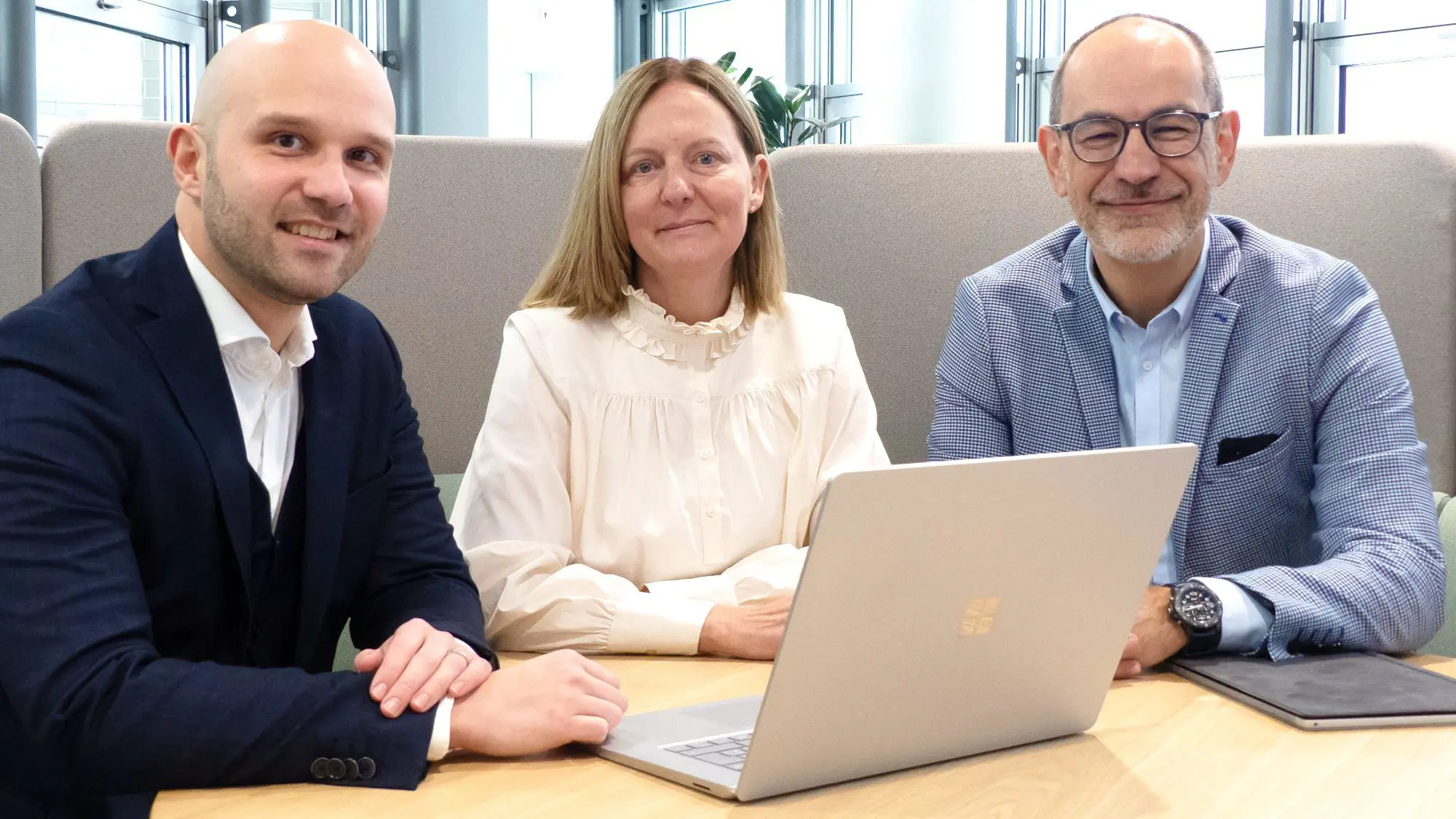
At the round table with Claudia Andersson, Head of Benefit Services Private Retirement Provision, Daniel Maillard, Head of Service Centre Private Retirement Provision and Andreas Werneburg, Project Manager, from Pax.
By Ivana D’Addario, Marketing Manager at BBT
BBT Software and the insurer Pax dared to do something that has barely been tried in the Swiss insurance landscape: integrate a single standard software component into an existing, highly complex system. And they managed to do it successfully. After 14 months, BBTLife-Claims from the BBTLife suite was integrated into Pax’s IT landscape at the beginning of May 2022 without any malfunctions or errors. Since then, Pax has been handling its disability benefit claims in private retirement provision with BBTLife-Claims – also without any trouble.
It is rare for a software component to be introduced without any errors at all, with little effort for the customer, within the shortest possible time and at a fixed cost price. This kind of software integration is particularly remarkable in the Swiss insurance sector, where the system landscape is often outdated and therefore cumbersome. With a good twelve peripheral systems and various query interfaces, Pax’s IT infrastructure is also one of the most complex in the industry. At the round table, Claudia Andersson, Head of Benefit Services Private Retirement Provision, Daniel Maillard, Head of Service Centre Private Retirement Provision and Andreas Werneburg, Project Manager, from Pax talk about the various reasons why the integration of BBTLife-Claims at Pax was successful.
We can be a little bit proud that together we managed to implement BBTLife-Claims so smoothly, can’t we?
Daniel Maillard: It wasn’t a matter of course that we were going to achieve the ambitious goals we set for ourselves. But we knew from the beginning that it was possible and what it would take: the right partner, intensive preparatory work and creating the best conditions. In addition to the important technical aspects, the social components and the interaction of all the people involved in this project were of particular importance to us. All these factors had a positive influence on one another and led to success. I’m delighted with the level of commitment shown by everyone involved.
Claudia Andersson: In my opinion, the workshops where the use cases were discussed were fundamental. Thanks to the great know-how of the BBT project manager, these were designed extremely efficiently and with high quality. Furthermore, the back and forth between him and our project manager, Andreas Werneburg, worked very well; this could also be felt in the technical team. Information was exchanged and processed on a daily basis.
This sounds like something out of a textbook – and in fact it was. That said, there were certainly some unforeseen challenges. What was the matter-of-fact daily life like at Pax?
Andreas Werneburg: The start of the project was tough. The Covid19 measures decided by the Federal Council meant that we had to start the project from our home offices in 2021. Today, this is no longer something special, working from home has become run-of-the-mill. This was different when the project began: hardly anyone worked regularly from home. It was therefore all the more gratifying to see how self-disciplined everyone at Pax and BBT was from day one, delivering even without the immediate team dynamic. And although the project staff never got to know each other personally until the go-live in May 2022, a great atmosphere was immediately noticeable.
The high degree of discipline, which is also usual for us, was generally remarkable, whether it was assessing the interaction of all systems or deciding all work stages and coordinating them with one another. The right specialists always communicated with each other and the information flowed in an exemplary manner. That’s why something stands out in your answers: the social factor mentioned at the beginning. On your side, how did you ensure that this stayed centre stage even in the hectic day-to-day of the project?
Andreas Werneburg: We were very well positioned, for one thing. For another, it was possible to make decisions quickly thanks to short communication channels and a flat hierarchy. The fact that Pax maintains transparent communication has been very beneficial. This was also reflected in the fact that we invited everyone to a review demo after each release. At these, all interested parties could follow the progress of the project live, ask questions immediately and make other suggestions. This allowed us to avoid “nasty” surprises due to a lack of transparency.
Claudia Andersson: If something didn’t go smoothly – there’s no project in which everything always goes according to plan – it was very nice to see that everyone involved was always looking for solutions with pleasure and power. In a project of this size, this is incredibly motivating. A big thank you to the BBT and Pax project managers.
The introduction of BBTLife-Claims not only went smoothly, it was also delivered at the initially agreed fixed price. Implementations of this size are rarely offered at a fixed price. Moreover, a large number of IT projects exceed the planned budget. The chemistry between Pax and BBT was certainly right, but the agile approach, as far as it was at all necessary to introduce a piece of standard software, was the decisive factor. Is agile project management like this at BBT also part of Pax’s corporate culture?

Daniel Maillard: Pax has already been working with an agile setting in IT development for around five years. During all these years, we’ve continuously optimised and adapted our methodology – within the realm of our possibilities as well as our environment – until we finally found the optimal form of implementation for Pax. Hence the agile approach to IT matters is essential. The fact that BBT and ourselves have a working common ground in terms of agility meant that BBTLife-Claims could be integrated into our environment at record speed and in an excellent way. Furthermore, the simple and flexible coordination with BBT was decisive here.
Interestingly, general experience shows that when innovations are introduced in complex IT landscapes, it is risky and expensive to completely replace technical components. That’s why they are ideally introduced gradually and carefully. This is especially true in the insurance sector, where the system landscape is often old and has grown over a long time. Why are things different at Pax than perhaps at other insurers?
Andreas Werneburg: Pax has firmly anchored its IT strategy to keep it as close to the standard as possible. As a result, we prefer to adapt the established process – not the software. In other words: customising the software for Pax-specific wishes should be avoided whenever possible. Of course, this doesn’t apply to all cases: when it comes to life insurance policies, for example, policies are concluded over decades. This means that over time, insurance products are no longer offered or are offered at new conditions, while old contracts, on the other hand, continue to run. For such special cases, we make adjustments according to requirements.
We found each other, among other things, because modular construction using standardised software is BBT’s motto. Why is Pax so convinced of this approach?
Andreas Werneburg: Since the complexity of the used software is kept to a minimum over time and the cost of optimisation and further development is kept low, Pax benefits from consistently pursuing the standard software approach and thereby the chosen path. Our customers also benefit from this.
I’ve asked around internally: the project was very intensive. BBT delivered consistently functioning releases every fourth week. While Pax was testing one release, BBT was working on the next “components” in parallel. Is this tight planning also part of the successfully implemented project’s secret formula?
Andreas Werneburg: BBT has many years of experience in implementing their software and Pax knew what the requirements were thanks to the joint preliminary project. Our internal workshops were definitely key in the project when it came to specifying the requirements. We therefore started with an outline and defined user stories together, which also formed the basis for testing.
But it has to be said: The individual, incredibly high-quality releases that were produced were clearly the result of Pax’s expertise coupled with BBT’s in-depth know-how as well as its extensive practical experience. This is also reflected in the low number of bugs compared to similar projects. I would also like to mention the excellent test management in this project.
Claudia Andersson: All technical staff were involved in the tests and, as software testers, they not only gained a profound insight into the program. It was important to us that they could also express their opinion and make suggestions for improvement. The team was greatly motivated by the chance to participate in the development of the new software as future users. On top of that, there was no need for additional training, as all employees were very familiar with the software via the tests.
Subsequent training was therefore not necessary. Has this proved sustainable? What do your staff say now?
Claudia Andersson: 100 per cent, yes. I can only recommend involving all employees in testing. This also ensures diversity in test management. While one test person concentrates on the quality of the data, the other focuses on the accuracy of the figures and the next in turn pays attention to the presentation. This is clearly advantageous.
Daniel Maillard: For Pax, it was important to get the technical team on board early in the project and integrate them as the central component. Building up know-how with the new software already in the project phase has proven to be really beneficial. This made it possible to create a high level of acceptance of the new software among the employees.
Last but not least: Do you think are any other similarities between Pax and BBT?
Daniel Maillard: Shared, strong commitment, acting as partners at eye level and the clear focus and will to successfully implement a project. And all this with the high motivation and passion of all those involved. I would also include here the advantages of BBT and Pax’s SME sizes with their short and fast decision-making paths.
Ms Andersson, Mr Maillard and Mr Werneburg, thank you very much for your participation in this exciting and collegial roundtable. I wish you the best of luck and continued success.
 Expertise for everyone – thanks to new Sunetplus training from the BBTSchool">